
$130M Meth Intercept: Pakistan Navy Disrupts Major Smuggling Route
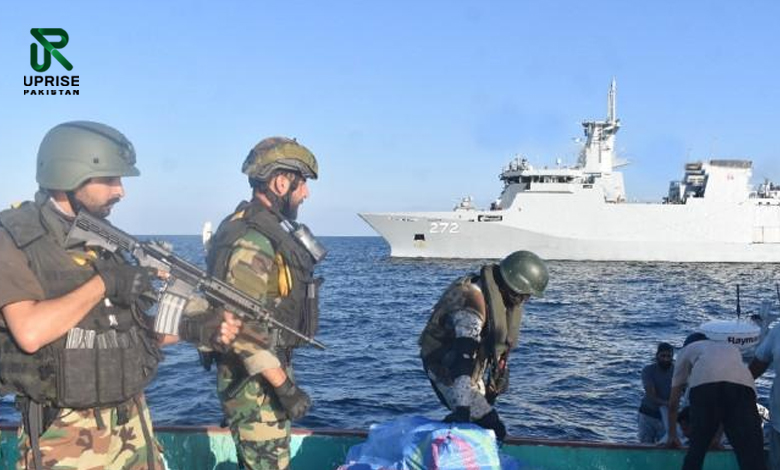
Before dawn, a Pakistan Navy ship closed in on a suspicious dhow in the Arabian Sea. Soon, sailors uncovered a massive cache of crystal meth. Officials valued the haul at about $130 million. For Pakistan, this was a big win against trafficking networks. For the region, it was proof that teamwork at sea can work.
Moreover, the intercept came on busy routes used to move drugs toward East Africa and the Middle East. Therefore, the operation is crucial for the security, trade, and coastal communities across the region.
The Intercept: How The Navy Caught The Smugglers
According to official briefings, PNS Tabuk was operating in the Arabian Sea as part of regional maritime security patrols. The ship also supported Combined Task Force-150 (CTF-150) during the interdiction. The boarding occurred in international waters near Pakistan’s maritime approaches. Notably, the vessel exhibited signs of being stateless, a common tactic employed by smugglers.
Details of the Seizure
Sailors seized over 2,000 kilograms of methamphetamine, also known as “ice.” Authorities estimated the haul to be approximately $130 million. The crew was detained for investigation, and the narcotics were secured as evidence. This was one of several major busts by the Navy in recent months.
| Item | Quantity/Value |
| Drug Type | Crystal Meth (Ice) |
| Total Weight | Over 2,000 kilograms |
| Street Value | ≈ $130 million (USD) |
| Suspects Detained | Crew detained (number not disclosed) |
| Vessel Origin | Stateless dhow |
Who’s Behind The Meth Trade?
Experts say meth trafficking in this region links to networks spanning Afghanistan, Iran, and Pakistan. Routes exploit porous borders and busy sea lanes before moving the product onward. Consequently, maritime chokepoints have become prime targets for interdiction. UN assessments note rising meth flows across the Indian Ocean region.
Links to International Cartels
Smugglers often ship bulk loads by sea to staging hubs in East Africa and the Gulf of Oman. Then, smaller parcels spread to global markets. Recent interdictions show organized groups using dhows, relay transfers, and fake flags to mask origin. Therefore, large-scale seizures at sea significantly impact supply chains.
Pakistan Navy’s Role In Maritime Security
The Navy has increased counter-narcotics patrols with the Anti-Narcotics Force (ANF) and international partners. Ships deploy long-range sensors, share intelligence, and utilize targeted boarding teams. As a result, detection has improved along the Arabian Sea corridor.
Recent Interceptions by Pakistan Navy
In October, Pakistan Navy units—working with CTF-150—made record seizures nearing $1 billion across multiple dhows. Those hauls included tons of meth and smaller amounts of cocaine. Together, these cases have lifted Pakistan’s profile in regional maritime policing.
Global Implications Of The $130M Bust
When authorities remove two metric tons from supply, wholesale networks feel the shock. Prices can rise, risks increase, and downstream deliveries slow. Meanwhile, intelligence from the bust can expose contacts, routes, and financiers. Thus, a single seizure can disrupt multiple future consignments.
Recognition from Global Agencies
The Combined Maritime Forces emphasized the importance of joint patrols and the sharing of data during these operations. Such recognition supports future funding, training, and equipment for regional partners, including Pakistan. Moreover, consistent results build credibility with agencies like UNODC.
Challenges In Curbing Maritime Drug Smuggling
The ocean is huge, and assets are finite. Smugglers use unregistered boats, spoofed flags, and mid-sea transfers to slip past patrols. Therefore, success depends on good intelligence, fast response, and cooperation across borders.
Legal and Jurisdictional Loopholes
“Stateless” vessels complicate arrests and prosecutions. Courts must weigh evidence chains, crew identities, and flag issues. As a result, coordination among neighbors becomes essential to close legal gaps and secure convictions.
Looking Ahead: Strengthening Pakistan’s Drug Enforcement
Next steps could include the development of long-endurance drones, enhanced ISR aircraft, and expanded satellite tracking capabilities. Continued work with CTF-150 and its neighboring states, including Iran and Oman, can enhance surveillance across chokepoints. In turn, interdictions should become faster and safer.
Public Awareness and Internal Reforms
Sea seizures must pair with action ashore. This involves mapping domestic networks, tracing financial transactions, and assisting coastal communities in resisting trafficking. UNODC urges full-chain strategies, from precursors and labs to couriers and kingpins. Ultimately, fewer hands on the shore means fewer boats at sea.
“Record meth seizures point to industrial-scale trafficking. Maritime routes are now central.”
A Major Win In The Fight Against Maritime Smuggling
This $130 million intercept is a win for Pakistan and a warning to traffickers. However, smugglers adapt fast. Therefore, navies, coast guards, and agencies must keep sharing intel, upgrading tools, and closing legal gaps. Every ton stopped at sea protects families far inland—and pushes criminal networks back into the shadows.


