
Smartwatch AFib alert sends dad to ER before heart surgery

NEWYou can now listen to Fox News articles!
When Joseph Holycross came home from work feeling off, he had plenty of reasons to brush it aside. He was a busy father of four, worked long hours and had grown accustomed to blaming a racing heart on caffeine and exhaustion. His wife, Jamie, saw something that worried her. She urged Joseph to use the ECG feature on his Samsung Galaxy Watch4 Classic. Seconds later, the result gave him a reason to stop making excuses and head to the emergency room. What doctors discovered would lead to a week in the hospital, open-heart surgery and new health concerns for Joseph’s family. It also completely changed the way he looks at the smartwatch on his wrist.
Missed CyberGuy LIVE? Watch the replay and discover 5 ways AI can help you get better healthcare.
Our free CyberGuy LIVE class Get Better Healthcare With AI has ended, but you can still watch the full replay. Kurt “CyberGuy” Knutsson walks you through five practical ways AI can help you prepare for appointments, remember important details, understand complicated medical information, research prescription questions and organize your next steps. No technical experience is needed.
Plus, recordings of all our past classes are available, including How to Stop Spam, Phone Security and Financial Protection, each with a free downloadable checklist.
Watch the free replays and get your checklists at CyberGuyLive.com
CAN WEARABLES DETECT HEART PROBLEMS EARLY? DOCTOR BREAKS DOWN REAL DATA
Joseph Holycross and his wife, Jamie, say a Galaxy Watch ECG reading helped convince him to seek emergency care after she noticed he was short of breath. (Kurt “CyberGuy” Knutsson)
Joseph thought his racing heart had an explanation
Joseph says the elevated heart rate had been happening on and off for roughly a year and a half to two years. At the time, just weeks before his 40th birthday, he did not see it as a warning sign. “I tend to fuel with caffeine. I’m a father of four, so, you know, we tend to drink coffee and things like that when we’re tired to kind of push through the day,” Joseph told CyberGuy.
That made the symptoms easier to explain away. If his heart was racing, Joseph could point to coffee, exercise or a long day and keep going. Then Jamie noticed something different. “She had made the comment that I looked like I was short of breath, like I was breathing strangely,” Joseph recalled. Jamie works as a respiratory therapist, so her concern carried weight. This time, Joseph agreed to check his heart with the ECG feature on his Samsung Galaxy Watch4 Classic.
His Galaxy Watch showed AFib
Joseph had owned his Galaxy Watch4 Classic for about three years. Before this happened, health monitoring was hardly the reason he wore it. He mainly liked being able to receive messages or answer calls while he worked without carrying his phone around the shop. He had tried the ECG feature perhaps once about a year earlier, mostly to see what the watch could do. This time was different.
Joseph scrolled to the ECG feature, tapped the option to record and followed the directions on the screen. He says the watch instructed him to remain still and keep his finger on the sensor while it recorded for about 30 seconds. “It came up and told me immediately at the top in bold letters, atrial fibrillation,” Joseph said. His reaction was immediate too, but it was not fear.
“Denial,” Joseph said. “I just thought it had to be a malfunction. I wasn’t even 40 yet.” He wondered whether the watch could be wrong, especially because it was an older model. So he ran the ECG again and then repeated it several more times. Jamie was not interested in continuing to test it at home. Joseph recalls her telling him, “We need to go to the ER and have an actual EKG done just to make sure.”
AI MAY SPOT DEADLY HEART RISK IN A ROUTINE ECG
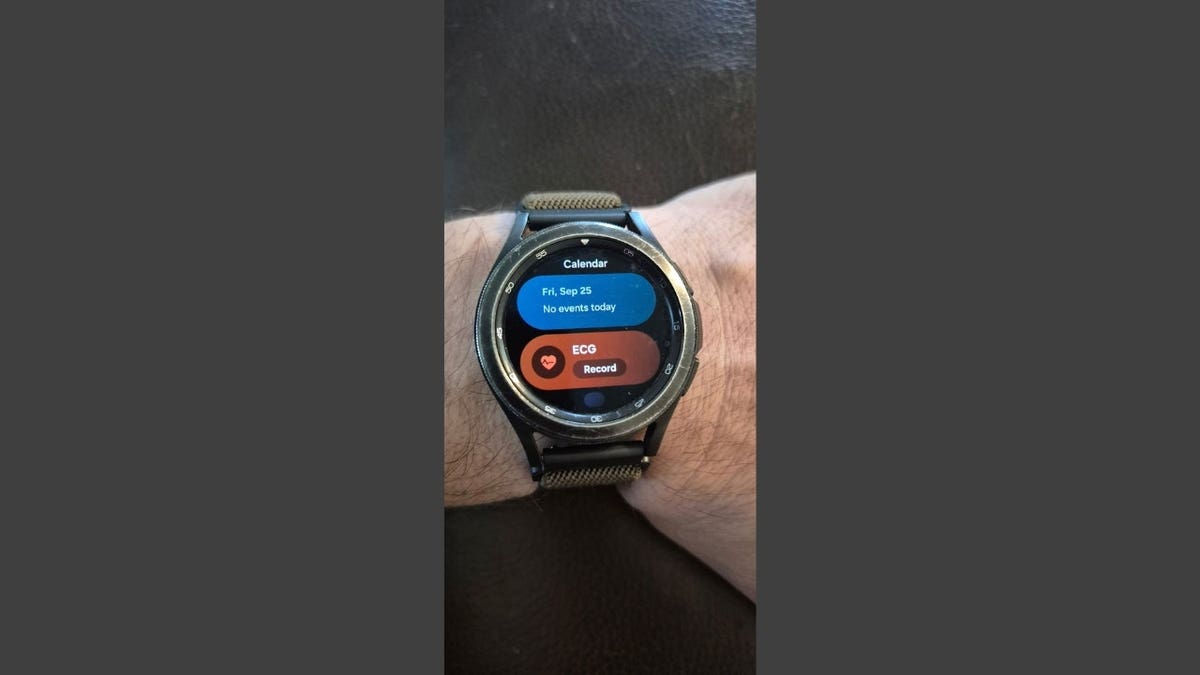
Joseph’s Samsung Galaxy Watch4 Classic includes an ECG feature that can record his heart rhythm and flag a possible AFib result. (Kurt “CyberGuy” Knutsson)
The watch changed Joseph’s mind about going to the ER
When I asked Joseph whether he would have gone to the emergency room that day without the watch, he did not hesitate. “Nope,” he said. That answer gets to the heart of this story. The Galaxy Watch did not determine everything that was happening inside Joseph’s heart. It gave him information that made his symptoms much harder to dismiss.
Joseph sent the watch’s ECG recording to his phone and brought it with him to the hospital. He says an ER doctor reviewed the tracing and confirmed that he was in AFib. Jamie remembers being struck by how closely the watch’s result resembled what doctors were seeing. “The doctor was kind of impressed that it actually even looked like the rhythm that it showed looked like atrial fib,” she said. Joseph expected to get checked out. Instead, he stayed in the hospital for about a week while doctors worked to understand the problems affecting his heart. Then came another major turn. About 10 days later, Joseph says he returned for open-heart surgery. “They had several things on my heart that they had to repair,” he said.
Jamie says doctors warned them what could have happened
For Jamie, the experience reinforced something she had already seen through her work in healthcare. Wearable health data can give people useful information, but they have to take concerning results seriously and seek professional medical care. She says doctors warned the couple about what Joseph could have faced had he continued attributing his symptoms to caffeine or exercise. “He probably would have had a stroke, heart attack, or both,” Jamie said.
The family also says one of Joseph’s doctors told them that without medical intervention, he likely would not have lived to see 45. That warning carries additional weight because Joseph had not considered himself someone with serious health problems. He was still 39 when his watch recorded the AFib reading. “It can happen to anyone,” Jamie said. She hopes their experience encourages people to learn what the health features on their devices can actually do instead of waiting until something feels wrong.
Hospital monitors gave Jamie another reason to trust the data
Jamie had another perspective during Joseph’s hospital stay because of her medical background. She says they compared the heart rate information on Joseph’s watch with the hospital equipment while he was being monitored. According to Jamie, the readings were sometimes within about one beat per minute of the hospital monitor. That does not make a smartwatch a replacement for hospital equipment, but seeing the numbers track so closely left an impression on both of them.
“I would definitely encourage people to take it seriously for sure,” Jamie said. She views the watch as a tool that can give someone a reason to seek a professional opinion rather than something that should make medical decisions for them.
Doctors raised concerns for Joseph’s children and siblings
Joseph’s medical journey also created new questions for the rest of his family. He says doctors told him that some of the problems involving his heart could have a genetic component and that some may have been present since birth before gradually becoming more noticeable.
That prompted doctors to recommend additional screening within the family. Joseph says his siblings have been encouraged to get checked for the same issues. His children will also need to undergo screening when they are adults. “It brought up a lot of concern,” Joseph said. For a father of four, the discovery suddenly extended beyond his own recovery. The medical information doctors uncovered could potentially help his siblings and children watch for similar problems earlier.
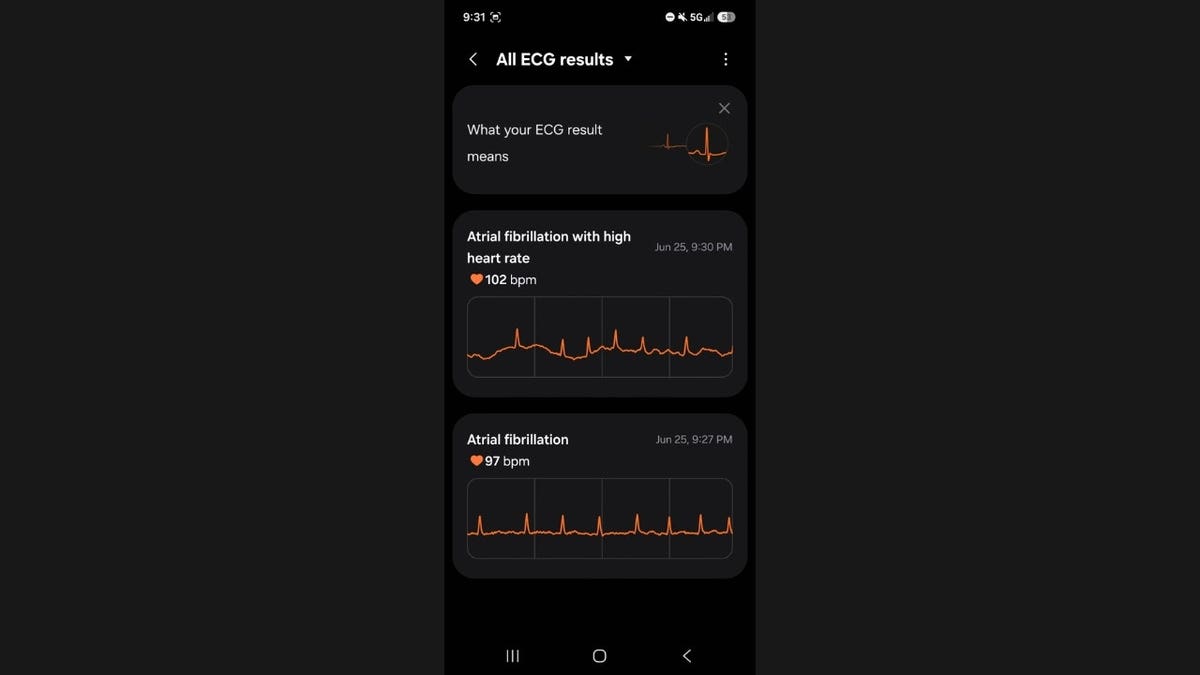
Joseph says his watch recorded atrial fibrillation, including one reading with a high heart rate, before doctors confirmed he was in AFib at the hospital. (Kurt “CyberGuy” Knutsson)
What the Samsung Galaxy Watch ECG can tell you
Samsung says the ECG feature in its Samsung Health Monitor app records the electrical activity of the heart using a compatible Galaxy Watch. The recording takes about 30 seconds. Depending on the recording, Samsung says the app can return results including sinus rhythm, atrial fibrillation, high heart rate, AFib with a high heart rate, an inconclusive result or a poor recording. Samsung says an AFib result means the watch detected an irregular rhythm during the recording and advises users who receive that result to contact their doctor for guidance. Anyone who receives an AFib result with a high heart rate should contact a doctor as soon as possible.
However, Samsung also cautions that its ECG feature does not replace traditional methods of diagnosis or treatment. Users should not interpret the device’s output or take clinical action based on it without consulting a qualified healthcare professional. That difference is important in Joseph’s case. His watch gave him an AFib result. Medical professionals then evaluated him and determined what treatment he needed.
How to take an ECG on a compatible Galaxy Watch
On Samsung’s current software, the ECG feature works through the Samsung Health Monitor app on compatible Galaxy Watches paired with a compatible Galaxy phone. Availability and requirements can vary by device and region. To record an ECG, Samsung says to wear the watch snugly and rest your forearms comfortably on a table. Open Samsung Health Monitor on the watch and select ECG. Lightly rest a finger from your opposite hand on the watch’s top button without pressing it, remain still and avoid talking while the watch records for 30 seconds.
For the best reading, Samsung recommends sitting still beforehand, making sure the sensor is clean and dry and wearing the watch snugly so it lies flat against your wrist. Movement or poor skin contact can lead to a poor recording.
Once the recording finishes, the result appears on the watch and can sync to the Samsung Health Monitor app on the paired phone. You can then review your ECG history and share a report with a healthcare professional. If you have symptoms that could indicate a medical emergency, do not wait for a smartwatch result before seeking emergency care.
For Joseph, the watch now brings peace of mind
After open-heart surgery, every strange feeling can carry more weight than it did before. Joseph described how even a small pain can make him wonder whether something is wrong again. Being able to check his heart rate and rhythm does not eliminate that concern, but he says it gives him reassurance. “You don’t have to sit and worry, ‘Oh, am I in AFib again?'” Joseph said. “I can check and, you know, it’s a reliable source. It kind of puts you at peace.”
He has also been using the watch during his recovery to track his walking, steps and exercise. Before his medical ordeal, many of those health tools went unused. Now Joseph says the watch leaves his wrist mainly when he needs to charge it. “It’s really been a peace of mind type” of device, Joseph said.
Jamie hopes people learn what their watches can do
Jamie says one of the lessons she wants other people to take away is surprisingly simple: If you already own a smartwatch with health features, learn how to use them. She sees people, including some who work in healthcare, use smartwatches primarily for steps or everyday notifications while ignoring other available tools. “I think the reassurance it gives people is amazing for anyone who even has, you know, cardiac issues,” Jamie said.
Joseph agrees. Before this happened, he knew his watch had additional capabilities, but he had little reason to explore them. Now he wants people to understand what may already be sitting on their wrists. “You’ve got to know that it’s a lot more than just a watch,” he said. For Joseph, that lesson became deeply personal. The watch did not perform his surgery or replace the doctors who diagnosed and treated him. What it did was give a busy 39-year-old father information that finally persuaded him to stop explaining away how he felt and head to the hospital.
Kurt’s key takeaways
What stays with me about Joseph’s story is that he came incredibly close to doing what many of us have done at one time or another: convincing himself there was a perfectly reasonable explanation for feeling off. He was working hard, drinking caffeine and raising four kids. A racing heart fit easily into the story he was already telling himself. Jamie noticed something different and pushed him to check. Then the watch gave Joseph a result he could no longer comfortably ignore. That combination ultimately got him through the doors of an emergency room. No smartwatch can tell you that you are healthy, and a reassuring reading should never override symptoms that concern you. Samsung makes that limitation clear. But Joseph’s experience shows why the information these devices collect can be useful when it prompts someone to pay closer attention and talk to a healthcare professional. There is also a powerful family piece to his story. What doctors discovered led to new screening concerns for Joseph’s siblings and, eventually, his children. A health scare that started with a 30-second reading on his wrist may now give other members of his family an opportunity to ask questions earlier.
If your smartwatch warned you about a possible health problem but you felt fine, would you head to the doctor or be tempted to dismiss the alert? Let us know by writing to us at Cyberguy.com
Sign up for my FREE CyberGuy Report
- Get my best tech tips, urgent security alerts and exclusive deals delivered straight to your inbox.
- For simple, real-world ways to spot scams early and stay protected, visit CyberGuy.com – trusted by millions who watch CyberGuy on TV daily.
- Plus, you’ll get instant access to my Ultimate Scam Survival Guide free when you join.
CLICK HERE TO DOWNLOAD THE FOX NEWS APP
Copyright 2026 CyberGuy.com. All rights reserved.
Source link


