
The Mind Behind the Words – Muhammad Awais

Muhammad Awais is a professional content writer and digital marketing expert with more than five years of experience in the field. He has worked with reputable digital marketing firms such as XperDigi, Elixier Ltd, and Builtin Soft, creating content that drives engagement and strengthens online presence across multiple niches.
As a published author, his articles have been featured in leading national and international English newspapers, including The Tribune, The Nation, The Patriot, The Financial Daily, and Pakistan Business Times. He has also written under the pen name “Ibn Abdul Razzaq,” a name under which many of his critical and research-based pieces have been recognized. Being a concerned citizen, Awais approaches these topics with a research-based mindset, offering in-depth analysis and proposing practical solutions aimed at fostering growth and progress. His vision is to see Pakistan flourish and take its rightful place among the comity of nations.
Alongside his journalistic contributions, Awais writes extensively on content strategy, digital marketing trends, and online branding, helping businesses and organizations strengthen their digital identity.
-

When Threat Becomes Policy: Israel and the Politics of Preemption
States rarely declare ambition in its raw form. They construct it, refine it, and present it as a necessity. In modern geopolitics, few tools are as effective as the language of “existential threat”—a phrase that does not merely describe danger, but legitimizes action before it is questioned. It transforms choice into compulsion and power into defense. When invoked persistently, it does something more consequential: it turns policy into inevitability. Israel’s strategic posture today operates firmly within this framework. What began as a doctrine of survival in a hostile environment has evolved into a broader logic of preemption—one that does not wait for threats to materialize, but moves to define and confront them in advance. The line between deterrence and dominance, once guarded, has grown increasingly difficult to locate. The pattern is visible across multiple theatres. In Lebanon, repeated military campaigns have been framed as necessary to neutralize Hezbollah’s capabilities. Yet, they have also entrenched a cycle where destruction becomes a language both sides understand too well. In Gaza and the Palestinian territories, operations justified under security imperatives have extended far beyond immediate defense, reshaping the political and humanitarian landscape in ways that outlast any single conflict. With Iran, the confrontation …
-
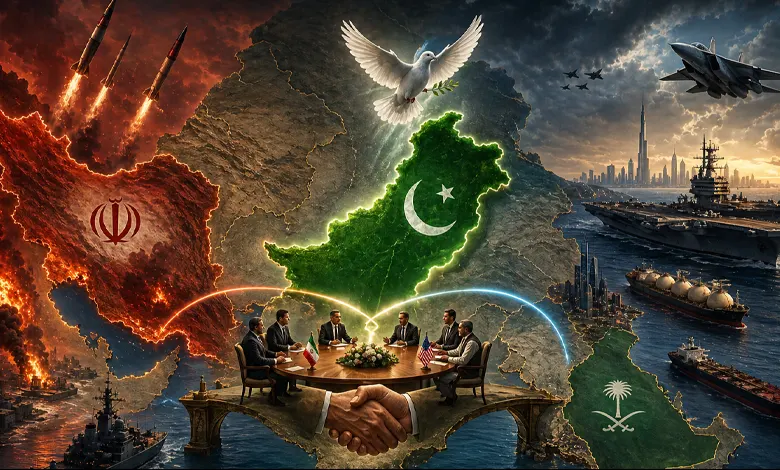
Pakistan Between Firelines: Diplomacy in the Iran Crisis
States do not sit across negotiating tables because they trust one another; they do so because the cost of not talking has become greater than the cost of talking. Negotiation, in political terms, is not a gesture of goodwill—it is a calculated pause in confrontation, a space where rivals attempt to manage conflict without surrendering position. It is where power speaks in measured language, where threats are softened into proposals, and where silence itself can signal intent. Diplomacy operates in this narrow corridor between action and restraint, where every word is weighed not for what it says, but for what it prevents. It is within this uneasy space that Pakistan has found itself—hosting, facilitating, and attempting to steady a dialogue that reflects less agreement than necessity. The first round lasted close to twenty-one hours, long enough to show intent but not enough to produce alignment. It ended not in a breakthrough, but in a stalemate that carried the negotiations forward into a second phase. That second round, however, revealed something deeper than disagreement. Iranian officials arrived in Islamabad, held their meetings, and departed the very next day. The American side did not show up. In diplomacy, absence is never neutral. …
-

Iran After Khamenei: The War at Pakistan’s Door
The news of Ayatollah Ali Khamenei’s death lands in the region like a door slammed in the middle of the night: not just startling, but final, and impossible to ignore. For years, he stood as the Islamic Republic’s unbending face—an old cleric with a state behind him—speaking the language of resistance when much of the Muslim world learned the safer grammar of caution. To his supporters, he was a rare figure who refused to bow before the coercion of Washington or Tel Aviv, and who treated sanctions, threats, and isolation as the price of dignity rather than the cost of miscalculation. Whatever one thinks of the Iranian state’s own hard edges, Khamenei’s political life was built on a single idea: that Western power, and Israel’s regional dominance, should not be accepted as fate. Now the man is gone, and the argument he embodied has not ended—only been released into a far more volatile form. What follows is not merely the question of who replaces him or which faction gains the upper hand in Tehran. The deeper issue is that a pillar has been removed while the structure is still shaking. In that moment, symbols matter as much as missiles. Khamenei …