Pakistan Between Firelines: Diplomacy in the Iran Crisis
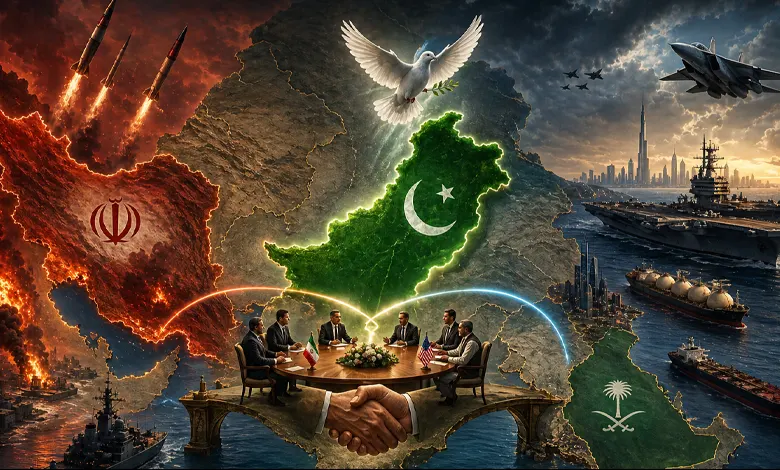
States do not sit across negotiating tables because they trust one another; they do so because the cost of not talking has become greater than the cost of talking. Negotiation, in political terms, is not a gesture of goodwill—it is a calculated pause in confrontation, a space where rivals attempt to manage conflict without surrendering position. It is where power speaks in measured language, where threats are softened into proposals, and where silence itself can signal intent. Diplomacy operates in this narrow corridor between action and restraint, where every word is weighed not for what it says, but for what it prevents.
It is within this uneasy space that Pakistan has found itself—hosting, facilitating, and attempting to steady a dialogue that reflects less agreement than necessity.
The first round lasted close to twenty-one hours, long enough to show intent but not enough to produce alignment. It ended not in a breakthrough, but in a stalemate that carried the negotiations forward into a second phase. That second round, however, revealed something deeper than disagreement. Iranian officials arrived in Islamabad, held their meetings, and departed the very next day. The American side did not show up.
In diplomacy, absence is never neutral. It is a message.
Pakistan now finds itself navigating not just between two adversaries, but between two different rhythms of engagement. Tehran appears willing to remain visibly present, even if inflexible. Washington, by contrast, signals from a distance—engaged, but selectively; involved, but not fully committed on the same stage. For a mediator, this imbalance is not a technical complication. It is a structural problem.
And yet, Pakistan cannot step back.
Geography has already made the decision. Iran is not a distant crisis that can be observed through statements and summits; it is a neighbor whose instability carries immediate consequences. From border security to sectarian sensitivities, from trade routes to energy dependencies, Pakistan does not have the option of disengagement. Its mediation is not an act of choice—it is an act of necessity.
But necessity does not guarantee leverage.
The extended first round of talks suggested that Pakistan could at least bring both sides into the same room, or close enough to simulate one. The fractured second round suggests something more sobering: that convening dialogue is not the same as controlling it. When one party arrives, and the other stays away, the mediator is left holding a process that risks appearing hollow.
This is the quiet danger of Pakistan’s position. It is visible enough to be held responsible, but not powerful enough to enforce outcomes.
Henry Kissinger once wrote, “The task of the leader is to get his people from where they are to where they have not been.” Pakistan’s diplomacy sits precisely in that uncomfortable space. It is trying to move a conflict away from escalation without possessing the authority to compel either side. That is not leadership in the traditional sense; it is navigation under constraint.
Another warning comes from Robert Jervis, who observed that in international politics, “States see what they expect to see.” In the context of these negotiations, that insight becomes more than theory. Iran reads American hesitation as a strategy. The United States may read Iranian urgency as pressure. Each side interprets the other through suspicion and, in doing so, reduces the space for compromise. Pakistan, standing in between, becomes less a bridge and more a surface onto which these perceptions are projected.
There is also a harder, almost cynical truth captured by Thucydides: “The strong do what they can, and the weak suffer what they must.” It is a line often quoted to describe power politics, but it applies just as sharply to mediation. Pakistan is not among the strongest actors in this conflict, yet it is exposed to many of its consequences. Its role, therefore, is not born of dominance, but of vulnerability.
The stalled negotiations reflect this imbalance. A twenty-one-hour session can demonstrate commitment, but it can also conceal the absence of real movement. A second round can signal continuity, but it can just as easily expose disengagement. When one delegation departs, and another does not arrive, the process begins to look less like diplomacy and more like choreography without coordination.
Still, even a flawed process has value.
In conflicts where escalation can occur through miscalculation, the mere existence of a channel—however uneven—can delay decisions that are otherwise made too quickly. Pakistan’s role, then, is not to resolve the Iran crisis in a definitive sense. It is to slow it down, to keep conversation alive long enough to prevent the worst outcomes from becoming inevitable.
This is a narrower ambition than what public narratives often demand, but it is also a more realistic one.
The real test for Pakistan is not whether it can force agreement between Tehran and Washington. It cannot. The test is whether it can maintain credibility while managing asymmetry—keeping both sides engaged even when their levels of engagement differ, preserving the process even when its substance is thin. That is a difficult balance to sustain. Too much visibility, and Pakistan risks being blamed for failure. Too little, and it risks becoming irrelevant. Too much alignment with one side, and it loses the other. Too much neutrality, and it loses influence altogether.
Pakistan’s role, then, is no longer just about managing the risks next door—it is about shaping how it is seen on the global stage. By stepping forward, hosting dialogue, and keeping communication alive when it could easily collapse, Pakistan is quietly strengthening its diplomatic standing. In a region where many choose silence or distance, this kind of engagement stands out. It shows that influence is not always about power—it is also about presence, timing, and the willingness to act. And if these efforts continue, Pakistan may not only help prevent a wider conflict, but also emerge with something equally important: a stronger voice in how the region’s future is decided.
The writer can be reached at: awais.army96@gmail.com