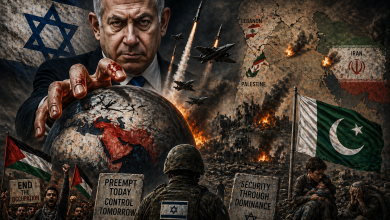
Iran After Khamenei: The War at Pakistan’s Door

The news of Ayatollah Ali Khamenei’s death lands in the region like a door slammed in the middle of the night: not just startling, but final, and impossible to ignore. For years, he stood as the Islamic Republic’s unbending face—an old cleric with a state behind him—speaking the language of resistance when much of the Muslim world learned the safer grammar of caution. To his supporters, he was a rare figure who refused to bow before the coercion of Washington or Tel Aviv, and who treated sanctions, threats, and isolation as the price of dignity rather than the cost of miscalculation. Whatever one thinks of the Iranian state’s own hard edges, Khamenei’s political life was built on a single idea: that Western power, and Israel’s regional dominance, should not be accepted as fate.
Now the man is gone, and the argument he embodied has not ended—only been released into a far more volatile form.
What follows is not merely the question of who replaces him or which faction gains the upper hand in Tehran. The deeper issue is that a pillar has been removed while the structure is still shaking. In that moment, symbols matter as much as missiles. Khamenei was not only a decision-maker; he was a living claim that defiance could be institutional, permanent, even routine. His absence invites two equally dangerous interpretations: that Iran is weakened and can be pressed harder, or that Iran has nothing left to lose and must strike louder to prove it still exists. Either reading tightens the spiral.
For the Gulf monarchies, this is the kind of crisis that turns geography into a liability. Their cities glitter, their ports hum, their economies sell stability as a brand—yet they sit within reach of the very forces now seeking vengeance, deterrence, or both. In moments like this, alliances become traps. Security ties with the United States can deter, but they also paint targets. Silence can buy time, but it can also encourage escalation by inviting others to fill the vacuum. This is how regional wars expand: not through a grand plan, but through crowded fears and hurried messages that arrive too late.
Pakistan, however, cannot pretend this is an external drama. Iran is not a headline at a distance; it is a border, a neighbor, a map you cannot fold away. From Quetta to Gwadar, from the uneasy politics of sectarian tension to the hard arithmetic of refugees and smuggling routes, Pakistan already carries the weight of regional instability in its daily life. A wider confrontation will not need to “reach” Pakistan. It is already at Pakistan’s threshold.
And yet the public posture from much of the Muslim world has been a familiar one: statements calibrated to offend no one, gestures designed to be quoted and forgotten, concern expressed in the abstract while the region’s future is negotiated elsewhere. Pakistan’s position has been especially exposed—caught between moral language that resonates domestically and strategic dependencies that shape policy quietly but decisively. The result is a paralysis that looks, to ordinary people, like helplessness; and to outside powers, like availability.
There is a warning here, and it is not new. Hannah Arendt wrote, “Power and violence are opposites; where one rules absolutely, the other is absent.” The line is often read as philosophy, but it is also a diagnosis: when political authority loses its grounding, force rushes in to compensate. Khamenei’s death risks producing precisely that condition—inside Iran, across its alliances, and among its adversaries. Everyone will speak of “deterrence,” but deterrence is not a spell; it fails when each side believes the other understands only punishment.
Two arguments from modern political thought help explain why this moment is so perilous.
First, in Perception and Misperception in International Politics, Robert Jervis shows how states routinely misread each other’s intentions, especially during crises, and how defensive actions are interpreted as preparations for attack. That dynamic is magnified in the Middle East, where history supplies every actor with a catalogue of betrayals to expect. A missile defence system becomes an offensive signal. A military exercise becomes a rehearsal. A diplomatic message becomes a trick. In such conditions, escalation can occur even when leaders privately prefer restraint, because they fear the cost of being the only one who pauses.
Second, Graham Allison’s Destined for War popularized what he calls the “Thucydides Trap”: the idea that when a rising power challenges an established one, the risk of conflict increases—not because war is desired, but because suspicion becomes structural. Translate that framework to this crisis, and the picture sharpens. Iran, long treated as the region’s permanent challenger, has built its identity around resisting an order it did not design. The United States and Israel, determined to prevent Iran from altering that order, treat Iranian capability itself as provocation. The Gulf states, wary of Iran but wary too of being battlefield real estate, are pulled between protection and exposure. Pakistan, bound by geography and divided by pressures, becomes the uneasy hinge on which consequences swing.
This is why the argument that “Muslim countries are just watching” is more than a moral complaint. It is a strategic description. When regional states surrender initiative, they invite other capitals to write the script. When they avoid collective action, they accept collective risk. When they speak only in safe phrases, they concede the future to those willing to speak in threats.
What would a different posture look like for Pakistan and the Gulf? It would begin with admitting that neutrality is not cost-free when the fire is next door. It would mean treating de-escalation as an active policy, not a prayer—pressing for channels that prevent miscalculation, demanding limits that reduce civilian exposure, and refusing the quiet normalization of strikes and reprisals as if this were weather. It would also require a franker conversation inside Pakistan: that public emotion, however understandable, cannot substitute for statecraft; and that dependency—economic, military, diplomatic—always comes with a price, especially when the region is burning.
Khamenei’s supporters will mourn him as a symbol of resistance. His opponents will call his end a strategic breakthrough. Both may be premature. In the Middle East, the death of a leader rarely settles an argument; it usually breaks it into sharper pieces. Pakistan and the Gulf must decide whether they will remain spectators to that fragmentation, or whether they will act like states that understand a simple fact: when war is at your door, watching is also a choice—and history keeps the receipt.
The writer can be reached at: awais.army96@gmail.com