
Egyptians exhume the dead as historic cemetery faces demolition

Cairo: Twenty years after burying him, Egyptian architect Ahmed el-Meligui was forced to exhume his grandfather’s remains from a historic Cairo cemetery that is being partially razed to accommodate the growing mega-city.
“Death itself is a tragedy. Here, you are reliving that tragedy all over again,” said the 43-year-old, who had 23 other relatives also removed from their family tomb, located in a sprawling cemetery known as the City of the Dead in Old Cairo.
Since 2020, thousands of graves have been demolished at the UNESCO-listed World Heritage site, one of the oldest necropolises in the Muslim world.
It is the latest piece of Cairo’s history to be torn apart as authorities aggressively remake parts of the city, a longtime cultural beacon of the Arab world.
The Egyptian government says the cemetery’s destruction is necessary to build new roads and bridges that they hope will improve traffic in the congested, densely populated capital, home to around 22 million people.
But it is a painful ordeal for families like Meligui’s, whose 105-year-old family tomb, built in traditional Islamic style with grand wooden doors and a spacious courtyard, is slated for demolition.
“I had to separate the bones of the men from the women,” the father of three said.
“The most heartbreaking moment was when I found the shroud of my grandfather, who raised me, torn and tattered. The bones fell down and I had to gather them up from the ground,” he said, holding a photo of his maternal grandparents and their four children taken more than 50 years ago.
Speaking from his luxury home in west Cairo, Meligui said he had the remains transported in a hearse to be reinterred at a new cemetery in Fayoum province, around 100 kilometres (60 miles) away.
‘Indescribable pain’
The Egyptian government has offered alternative burial sites outside Cairo to families, but these cemeteries are smaller and more remote, according to several people whose families have tombs there.
An official at Egypt’s planning ministry told AFP the government “understands the grief of citizens” but said the process is ultimately for “the public interest”.
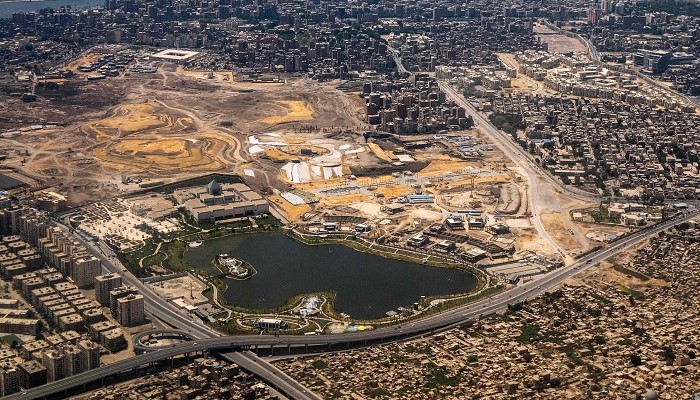
A massive concrete bridge now cuts through the cemetery, connecting Cairo’s eastern district of Mokattam with the central and western part of the capital — cutting the previous hour-long commute in half.
“The whole area has changed dramatically,” said Meligui, who owns a construction company.
Not far from his family’s burial ground, the Khayalah cemetery was completely razed in April 2020 and replaced with a bustling new multi-lane highway.
Mokhtar, a 63-year-old jewellery maker who asked to use a pseudonym to speak freely, said he felt “indescribable pain” when exhuming his family members, including his sister, just five months after her burial.
“Imagine digging up your family’s graves with your own hands and gathering their bones into bags,” he said.
Mokhtar, who used to visit the cemetery monthly, arranged for new shrouds and a hearse to rebury his maternal family’s remains in a government-provided lot.
“I moved my sister as she was, the body was completely intact with… blood,” he said.
‘Where should I go?’
Mokhtar said the new fast road that cuts through his family’s tomb is not worth the price.
“Easier or not. My loss cannot be replaced,” he said.
The destruction of Cairo’s cemeteries has taken a toll not only on the deceased and their families but also the thousands of people who have made the sacred grounds their home.
Since the 1980s, thousands of Egyptians have been living in cemeteries due to a severe housing crisis in the country of 107-million.
One such resident is Sayyed al-Arabi, 71, who has lived and guarded a cemetery in Old Cairo for decades.
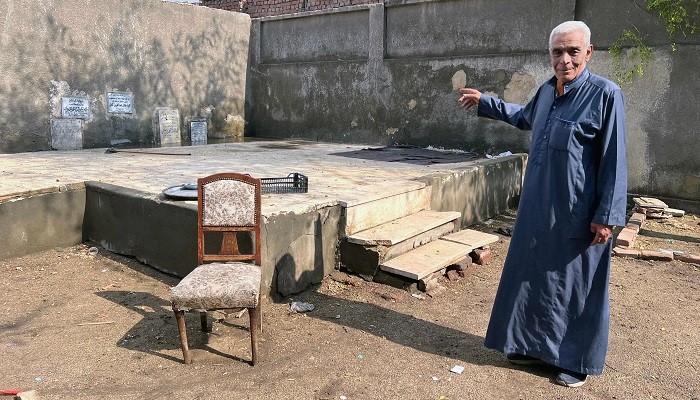
His one-room home, where his three children were born, is now surrounded by piles of rubble from demolished tombs. Outside, a bulldozer levels the unpaved ground, puddled with water.
“They told us they would remove the bodies and demolish the cemetery,” he said, a television hanging on the wall next to two dilapidated beds and a rusty fan.
In the spacious courtyard of the cemetery built in 1925, Arabi’s granddaughters played under the watchful eyes of their mother as she washed clothes.
“The owners of the graves will receive a replacement, but what about me? Where should I go?”


