
Pakistan Responds Forcefully After Indian Missile Strikes on Civilians
Retaliatory strikes launched following unprovoked aggression
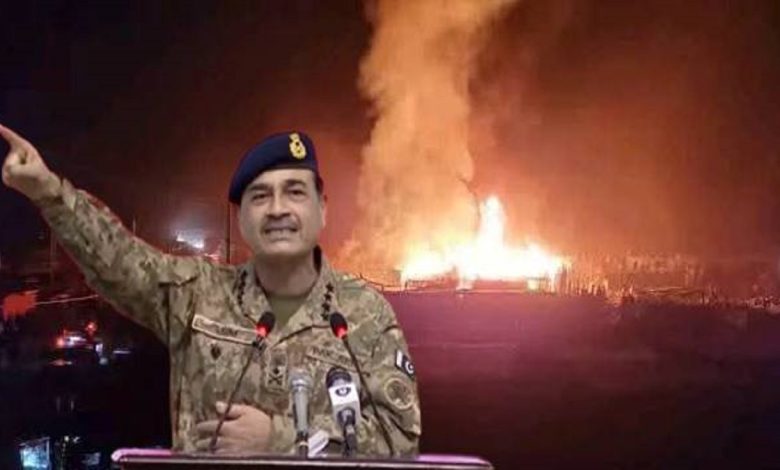
At least three civilians were martyred and a dozen others injured when Indian forces launched a surprise missile attack on Pakistani territory late Tuesday, according to the Director-General of Inter-Services Public Relations (ISPR), Lt Gen Ahmed Sharif Chaudhry. The assault, which struck the cities of Bahawalpur, Muzaffarabad, and Kotli, has sparked a swift and decisive counter-response from Pakistan’s armed forces.
Unprovoked Missile Strikes Spark Outrage
The Indian missile strikes, which targeted civilian areas deep inside Pakistani territory, have been widely condemned by both Pakistani officials and independent observers. Images circulating from the affected regions show widespread destruction to civilian infrastructure and personal property. Eyewitness accounts confirm that no military installations or combatants were present in the targeted zones, further underlining the disproportionate and indiscriminate nature of the attack.
Lt Gen Chaudhry expressed deep sorrow over the loss of innocent lives and emphasized the gravity of the situation. “This is a shameful and cowardly attack carried out from within Indian airspace. The targeting of unarmed civilians is a clear violation of international law and fundamental human rights,” he said in a late-night press briefing.
Pakistan’s Armed Forces Respond Decisively
In response to the aggression, the Pakistan Air Force and Pakistan Army swiftly launched retaliatory strikes. Security sources told Geo News that Pakistan’s countermeasures were designed to deliver a “strong and proportionate response,” making it clear that any act of hostility will be met with formidable resistance.
“All of our air force jets are airborne. We have initiated defensive and offensive operations to ensure the protection of our sovereignty and our people,” Lt Gen Chaudhry confirmed. “Let me say it unequivocally—Pakistan will respond to this attack at a time and place of its choosing. This provocation will not go unanswered.”
Explosions were heard shortly after midnight in the mountainous region near Muzaffarabad, Azad Jammu and Kashmir. Witnesses reported a series of loud blasts, which led to a complete power outage across the city, plunging thousands into darkness. Emergency services were immediately mobilized, and rescue operations are ongoing in all affected areas.
Escalating Tensions Between Nuclear-Armed Neighbors
The latest developments come at a time of escalating tensions between the two nuclear-armed neighbors, who have long been at odds over the disputed region of Jammu and Kashmir. The situation deteriorated further after a recent attack on a group of tourists in Indian Illegally Occupied Jammu and Kashmir’s (IIOJK) Pahalgam, which left 26 people dead. Without presenting evidence, India hastily blamed Pakistan for orchestrating the attack, a charge Islamabad firmly rejected.
Pakistan categorically denied any involvement and offered to participate in an independent and credible international investigation to uncover the truth behind the tragic incident. However, instead of engaging diplomatically, India escalated matters militarily, risking a broader regional conflict.
International Community Urged to Intervene
Pakistani officials have called upon the international community, including the United Nations and major world powers, to take note of India’s reckless actions. They emphasized the need for urgent diplomatic intervention to prevent further escalation, which could destabilize the entire South Asian region.
Foreign Minister Ishaq Dar issued a statement urging the UN Security Council to convene an emergency meeting. “India’s unprovoked aggression threatens not only regional stability but also international peace and security. The world must hold India accountable for these violations of international law,” Dar said.
Commitment to Defending National Sovereignty
Lt Gen Chaudhry reaffirmed that Pakistan remains committed to safeguarding its territorial integrity and protecting its citizens. He reiterated that the sacrifices of innocent Pakistanis would not be in vain and that the armed forces are fully prepared to respond to any future provocations.
“We have shown restraint in the past in the interest of regional peace, but let there be no doubt—we have both the capability and the will to defend our nation,” he asserted.
As damage assessments continue, authorities have urged citizens to remain calm but vigilant. Hospitals in the affected regions have been placed on high alert, and humanitarian assistance is being coordinated to aid displaced and injured civilians.
The unfolding situation marks one of the most serious escalations between India and Pakistan in recent years. As both sides brace for potential further developments, diplomatic channels remain open—but fragile.


