
These Tiny Robots 50x Smaller Than A Hair Can Hunt And Move Bacteria
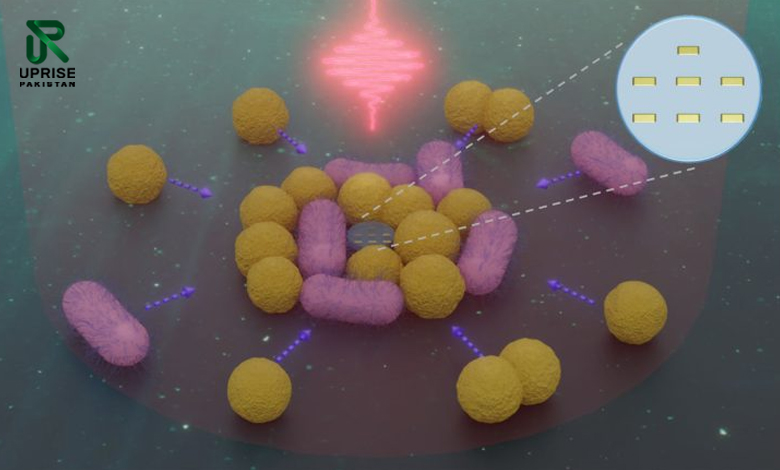
Tiny robots that chase bacteria sound unreal. However, a new study shows it can happen. Researchers built light-driven nanorobots that work in water-like liquid, where bacteria live. These robots are about 50 times smaller than a human hair’s width. Because they are so small, they can reach spots that tools cannot reach. The team showed the robots can steer with light. This matters because labs often need to sort or remove microbes in tiny spaces. The work appears in Nature Communications, and the University of Würzburg and Phys.org shared it. Also, it helps researchers watch the infection up close. In short, the “microscopic cleaner” idea is getting real.
How Small Are These Robots?
The researchers call them sub-micrometer nanorobots, which means they are smaller than one micrometer. They built them as tiny “antennas” that react to light. Because the robots sit in liquid, they face constant random bumps. Yet they still move on command. That scale matters, since bacteria often measure a few micrometers long. So, the robot can work close to a single cell. So, tiny moves can still change the whole experiment. What can it do in that space? It can search, approach, and handle microbes on purpose.
Key abilities include:
- Steer in two dimensions
- Turn sharply during a scan
- Carry bacteria, then release them
How Light Powers And Steers Them
Light does more than help us see. In this system, light also pushes the robot forward. The study uses photon recoil, which is a tiny kick from light’s momentum. The robot includes a plasmonic directional antenna that provides thrust and helps control orientation. The team did not need a tightly focused beam or moving mirrors, which can simplify the setup. Instead, they steered the robot by changing light polarization. With linear polarization, the robot’s travel direction locks to a set angle. Then, pulses of circular polarization help pick one direction when two options appear. The paper reports speeds up to 50 micrometers per second. One summary said, “We have built a light-driven nanorobot that can track down and collect bacteria.”
How The Robots “Hunt” Bacteria In Liquid
After the robot moves, it still needs a way to grab bacteria. The researchers used opto-thermophoretic attraction, which uses light-made heat patterns to pull nearby particles. In simple terms, the robot becomes a tiny “magnet” for microbes while it is lit. In the Nature Communications study, the team tested two bacteria types: Escherichia coli and Staphylococcus carnosus. The robot moved toward a target and drew the bacterium into a trapping zone. It also carried the bacterium along a planned path before releasing it. Because the trapping is reversible, the same robot can repeat the job. So, labs can sort bacteria without touching.
Main steps:
- Search
- Capture
- Transport
- Release
What The Team Proved In The Lab
The results focus on control, not medical use. Yet the lab tests were clear. The authors say the robots can “capture, transport, reversibly assemble, and release” bacteria. They also report that the robots can “clean” defined regions in a sample. As a result, a researcher can move microbes like game pieces.
| Item | What happened |
| Robot size | sub-micrometer |
| Speed | up to 50 μm/s |
| Bacteria | E. coli; S. carnosus |
Also, the team did this without beam steering or tight focusing. However, it still needs lasers, optics, and careful safety steps today. Therefore, the setup may be easier to copy in other labs.
Why This Discovery Matters
Bacteria cause sickness, yet they also help in food and nature. So, scientists often need to place bacteria in exact spots. They also need to remove unwanted bacteria from tiny areas. Until now, that kind of handling has been hard in water. This is why the team calls the robots “microscopic cleaners.” The robots can reach places where pipettes and tweezers can’t. They can also move a single bacterium without scratching the surface. In addition, they can gather bacteria into small groups for tests and separate them again when needed.
Potential lab uses include:
- Sorting mixed samples
- Testing how bacteria stick to surfaces
- Cleaning microfluidic channels
Still, researchers must test limits and avoid damaging cells with light over time.
What Happens Next For Tiny Robots
This research is a first step, not a final product. Still, it points to new ways to work at the cell scale. Next, teams may try more bacteria types and harder liquids. They may also test how well the robots work in crowded samples. So, more labs may try it. However, real medical use would need major proof of safety and control. For now, the best near-term impact is in lab tools. Scientists could “clean” micro channels, separate cells, or build repeatable bacteria patterns. Also, it may speed up antibiotic tests. In the end, these light-driven nanorobots show a simple idea: tiny pushes can guide tiny life.


