
This Gurugram founder collects the hair salons throw away and turns it into water-cleaning mats that trap oil and pollutants from dirty drains; here’s how the unusual idea works

What happens to the strands of hair swept off the floor after a haircut? For most people, the answer is simple: they go straight into the bin. But in Gurugram, something that is usually treated as salon waste is being given a rather unexpected second life- as a tool to tackle polluted water.Rahul Gupta, founder of the Kesakambali Foundation, has been collecting discarded human hair from salons and turning it into mats that can be placed in polluted drains and waterways. The idea may sound unusual, even improbable at first. Yet the science behind it is surprisingly simple: human hair can naturally absorb oils and certain contaminants.The initiative has now drawn attention for its attempt to use this everyday waste to intercept pollution before it reaches larger water bodies. According to a recent CNBC-TV18 report, the foundation’s HydroHair Barrier System uses mats made entirely from donated human hair, without synthetic fibres or chemical treatment.
From salon floor to polluted drain
The journey begins in places where nobody usually thinks of environmental innovation- salons. Hair cut during routine grooming is collected from participating salons and taken for processing. It is then turned into dense mats using a felting process. These mats are fitted into floating barriers and placed in polluted drains.As water moves through the barrier, the hair mats can trap suspended material and absorb oil and grease. The system also allows a natural biofilm to develop, with bacteria helping break down some of the organic pollutants. Speaking to CNBC-TV18, Gupta explained that the barrier is designed to work with the natural properties of hair rather than relying on electricity or chemicals. He also stressed that the system is not intended to replace conventional sewage treatment.“This is not a replacement for the STPs,” Gupta said, adding that the technology could instead improve their efficiency by reducing some pollution before wastewater reaches treatment infrastructure. That distinction is important. The technology is not being presented as a magic solution to India’s water pollution problem. Instead, its appeal lies in being a relatively simple intervention that can be deployed in drains where untreated or heavily polluted water is moving towards rivers.
What did the pilot show?
The foundation tested the system in a Gurugram stormwater drain, with water samples examined before and after treatment at an independent accredited laboratory. According to CNBC-TV18, the pilot showed a reduction in several pollution indicators. BOD levels, for instance, fell from 143 mg/litre at the inlet to around 80 mg/litre at the outlet. The testing also recorded changes in COD, total suspended solids and faecal coliform levels.However, there is an important caveat.The treated water still did not meet government discharge standards for all parameters. Gupta himself acknowledged that the system cannot be relied upon as a standalone treatment solution. For now, then, the idea is better understood as an additional layer of filtration rather than a replacement for sewage treatment plants.
Why hair?
The answer lies in the structure of the humble strand. Human hair is rich in keratin and has properties that make it capable of adsorbing oils and hydrocarbons. Similar hair-based mats have been explored in other parts of the world for absorbing oil pollution. That turns something routinely discarded into a potentially useful raw material.The Kesakambali Foundation describes itself as India’s first human-hair recycling initiative and says it works with hundreds of salons to collect hair waste. Its stated approach is to “cut, collect, transform and reuse” hair rather than allowing it to end up as conventional waste. The organisation says it has partnered with more than 700 salons and recycled hair into more than 100 products, highlighting how a waste stream from the beauty industry can potentially feed into a circular economy.
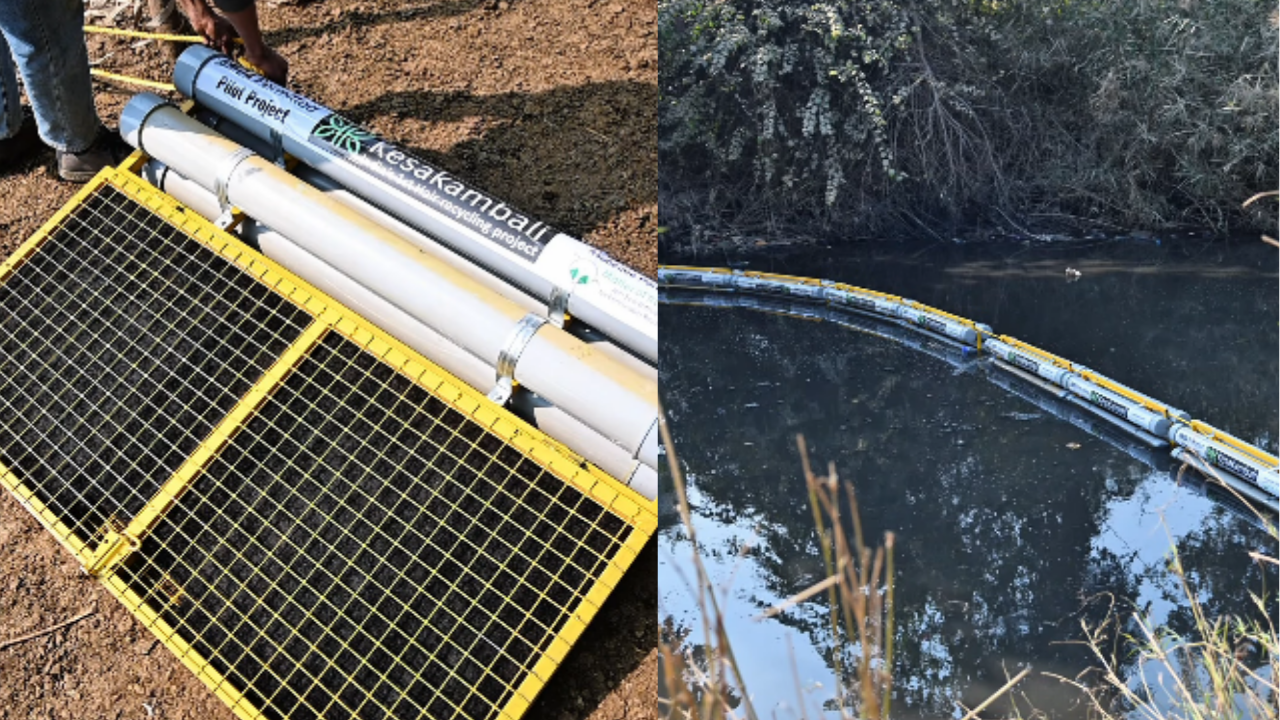
Photos: Instagram/@kesakambali
And what happens to the hair after it gets dirty?
This may be the most interesting part of the experiment. The mats are not simply meant to become another form of waste once they have absorbed pollutants. According to Gupta, once a mat reaches the end of its useful filtration cycle, its disposal depends on what it has absorbed. Mats contaminated with hazardous substances can be sent for appropriate waste-to-energy processing, while mats containing largely organic household waste can potentially be biologically treated and converted into mulch.In other words, the idea attempts to create a loop: hair that began as waste becomes a filtration material, performs a job in polluted water and can potentially be repurposed again.
A strange idea- but perhaps that is the point
Every day, hair is cut, swept away and forgotten. At the same time, cities spend enormous amounts trying to keep their drains and rivers from carrying oil, sewage and other pollutants into already stressed waterways. Gupta’s experiment asks a deceptively simple question: what if some of the things we call waste are actually resources we have simply failed to notice?The HydroHair system is still not a complete answer to India’s water pollution crisis. Its own pilot results show that it has limitations, and larger-scale, independent testing will be important to establish how consistently it works. But perhaps its most intriguing contribution is not just the possibility of cleaner drains. It is the idea that environmental solutions do not always have to begin with expensive machines or complicated infrastructure. Sometimes, they may begin with something lying unnoticed on a salon floor. And in this case, that something happens to be hair.
Source link


